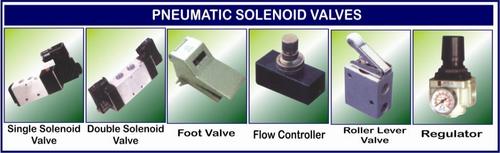
Riding on unfathomable volumes of industrial expertise, we are manufacturing, exporting and supplying an excellent range of Pneumatic Valves. Our team of adroit professionals manufactures these valves inculcating the most-advanced machinery, modern technology and quality assured raw material. The offered valves are used to control a huge amount of continuous flowing gas, oil, chemicals in various industries like refineries, petrochemicals and pharmaceuticals fields. Provided valves are properly tested by our quality controllers on various perimeters and customers can avail these Pneumatic Valves at reasonable price from us.
Features:
-
Robustness
-
Rust resistance
-
Simple to fit
Specifications:
SPOOL TYPE SINGLE AND DOUBLE SOLENOID VALVE
SIZE : 1/8 , ½, ½
TYPE : 5/2 , 3/2
VOLTAGE : 24VDC, 24VAC, 110VAC, 230VAC,
APPLICATION : AIR
PRESSURE : 0 TO 10 BAR
POPPET TYPE VALVE
SIZE : ½,3/4½ 1½
TYPE : 5/2 , 3/2
VOLTAGE : 24VDC, 24VAC, 110VAC, 230VAC,
APPLICATION : AIR, INERT GAS
PRESSURE : 0 TO 10 BAR
HAND LEVER OPERATED VALVE
SIZE : ½, ½ (5/2 , 5/3, 3/2)
TYPE : SPRING RETURN, DETEND
PRESSURE : 0 TO 10 BAR
APPLICATION : AIR
FOOT OPERATED VALVE
SIZE : ½, ½ (5/2 , 5/3, 3/2)
TYPE : SPRING RETURN WITH LOCK DOWN
PRESSURE : 0 TO 10 BAR
APPLICATION : AIR
COMPAIR/ELECTRO PNEUAMATIC VALVE
TYPE : 3/2 (N/C, N/O)
VOLTAGE : 24VDC, 24 VAC,110VAC, 230 VAC
APPLICATION : Air, inert gas
PRESSURE : 0 TO 10 BAR
COMPAIR MAKE SINGLE & DOUBLE SOLENOID VALVE
TYPE : 5/2 (N/C, N/O)
VOLTAGE : 24VDC, 24 VAC,110VAC, 230 VAC
APPLICATION : AIR
PRESSURE : 0 TO 10 BAR
These pneumatic solenoid valves adapt to a wide spectrum of industrial applications, with a working pressure of 0.15 to 0.8 MPa and compatibility with both DC and AC voltages. Their aluminum alloy body provides longevity and resistance to corrosion, while manifold options support multi-valve setups, meeting complex process requirements.
Electrical entry choices, including lead wire and DIN connector, simplify integration into automated systems. BSP and NPT thread types cater to various piping standards, ensuring straightforward setup. The compact 2.5W power consumption enhances energy efficiency and supports continuous operation in demanding environments.
FAQs of Pneumatic Valves:
Q: How do I select the correct port size and thread type for these pneumatic solenoid valves?
A: Choose a port size between 1/8 to 1/2 inch based on your airflow needs and system piping. Select either BSP or NPT threading according to your regional or project piping standards for a secure and leak-free connection.
Q: What are the electrical voltage options available for these valves, and when should I use each?
A: The valves support 24V DC and 220V AC. Use 24V DC for low-voltage, energy-efficient controls, especially in automated systems; select 220V AC for compatibility with industrial mains power where DC supply is unavailable.
Q: Where can these pneumatic solenoid valves be installed?
A: They are suitable for installation in industrial environments such as manufacturing plants, HVAC systems, and automated machinery, wherever controlled air flow is required. Their robust build and versatile connection options allow wide adaptability.
Q: What are the benefits of a manifold-type pneumatic solenoid valve?
A: A manifold configuration enables multiple valves to share a common air supply, simplifying installation, reducing piping, and supporting synchronized control of various process lines for enhanced operational efficiency.
Q: How does the aluminum alloy material enhance the valves performance?
A: Aluminum alloy offers a lightweight yet strong construction, ensuring durability and excellent resistance to corrosion in pneumatic applications. This extends the valves service life and reliability in harsh industrial settings.
Q: What process is involved in wiring these valves, and which electrical entry should I use?
A: The valves can be wired using lead wires for direct connections or DIN connectors for modular setups. Use lead wires for simple installations, and choose DIN connectors for quick replacement or maintenance in more complex systems.

 Send Inquiry


 Send Inquiry

 Send Inquiry
