Force Sensors About
We have marked a distinct position in the market by manufacturing, exporting and supplying a optimum quality Force Sensors. The offered sensor are manufactured by utilizing supreme grade materials with the help of our skilled professional team in compliance with the international market standards. These sensors are compatible for both static as well as dynamic applications for sensing the location or existence of the items. The provided Force Sensors are availed in different technical specifications to meet the exact need of our clients.
Features:
Specifications:
-
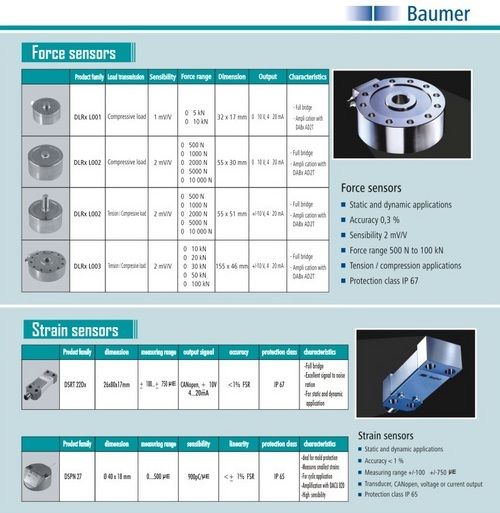
Static and dynamic applications
-
Accuracy 0.3%
-
Sensibility 2m V/V
-
Force range 500 N to 100 k N
-
Tension / Compression applications
-
Protection class IP 67
Strain Sensors
-
Static and dynamic applications
-
Accuracy < 1%
-
Measuring range +/-100 +/-750
-
Transducer, CAN open, voltage or current output
-
protection class IP 65
High Accuracy for Critical ApplicationsEngineered with a sensitivity of 2 mV/V and an impressive 0.5% full-scale accuracy, these stainless steel force sensors guarantee reliable force measurements. Their fine resolution and rapid response make them ideal for tasks that require utmost precision, such as automated quality control and robotic operation in industrial settings.
Durable & Versatile ConstructionBuilt to withstand harsh industrial environments, each sensor features a stainless steel body and IP65-rated protection against dust and splashes. The through-hole mounting design and compact profile facilitate seamless installation in tight machine setups. Their robust construction ensures consistent performance, even with frequent use.
FAQs of Force Sensors:
Q: How are these stainless steel force sensors typically used in industrial settings?
A: These force sensors are commonly integrated into automation systems, robotics, and machine testing setups to provide accurate, real-time force measurements. Their compact design and high durability make them perfect for managing quality control, monitoring load, and ensuring safety on production lines.
Q: What benefits do strain gauge-based sensors offer for force measurement?
A: Strain gauge technology allows for high precision and stability while measuring mechanical force. These sensors provide a fine resolution of 0.01 N and quick response time (<1 ms), enabling accurate feedback for process optimization and precise control in industrial applications.
Q: When should I choose a wired force sensor over a wireless version?
A: A wired force sensor, like this model, is ideal when you require consistent data transmission, minimal interference, and a robust connection in challenging environments. Wired versions are preferred for stationary equipment in automation, robotics, or testing rigs where maintenance and data integrity are priorities.
Q: Where can these force sensors be mounted for optimal performance?
A: These sensors are designed for through-hole mounting, allowing them to be securely installed in machinery and structural components. Their IP65 rating and 2-meter cable offer flexibility, accommodating various industrial layouts and protecting the sensor from dust and water ingress.
Q: What is the process for setting up this force sensor in a new application?
A: Installation involves securing the sensor using its through-hole mounting design, connecting the 2-meter cable to a suitable measurement interface with a 5 V DC supply, and calibrating the sensor using the systems settings to achieve optimal accuracy and performance.
Q: What advantages does the IP65 rating provide in industrial environments?
A: The IP65 rating ensures that the sensor is protected against dust ingress and low-pressure water jets, making it suitable for use in harsh industrial conditions. This enhances longevity and reliability, reducing maintenance frequency and operational downtime.

 Send Inquiry



 Send Inquiry

 Send Inquiry
