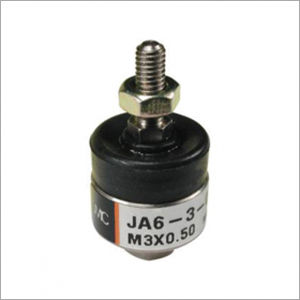
About Floating Joint
Aluminum or stainless steel made Floating Joint is considered as an integral part of mechanical and industrial equipments. Advanced CNC technology has been adopted to design this product. Chrome plated surface finish of this component makes it rust and wear proof. Its design has been generated in PDF or JPEG or CAD software. Certified by ISO, this Floating Joint is reckoned for its global threading standard and low maintenance design. High strength, precise dimension, compact shape and reasonable price are its key features.
Precision Engineering for Industrial AutomationDesigned for pneumatic cylinder automation and industrial machinery, our floating joints are built from high-quality carbon steel, stainless steel, or alloy. The nickel or zinc-plated finish offers exceptional durability and corrosion resistance, making them ideal for challenging environments. Their self-aligning features allow precision movement, even under frequent operational stress, ensuring reliability and reducing maintenance needs.
Simple and Versatile InstallationWith male-threaded connections and multiple thread size optionsincluding M5 x 0.8, 1/8" BSP, and 1/4" BSPinstallation is straightforward. Suitable for inline or direct cylinder mounting, these floating joints provide an adaptable solution for various pneumatic and mechanical setups. Box packaging ensures protection during transit and storage.
Absorbing Misalignment for Enhanced PerformanceOur floating joints are adept at absorbing alignment errors between cylinders and fixtures, allowing up to 3 mm stroke allowance and up to 5 of misalignment (model-dependent). This capability reduces wear on machinery, increases efficiency, and extends equipment lifespan, making these joints a valuable addition to automation systems.
FAQs of Floating Joint:
Q: How does a floating joint benefit pneumatic cylinder automation?
A: A floating joint compensates for minor alignment errors between pneumatic cylinders and fixtures. By allowing up to 5 of misalignment and accommodating 3 mm of stroke movement (depending on the model), it reduces stress on cylinder rods and machinery, leading to smoother operation and longer component life.
Q: What materials and surface finishes are available for the floating joint?
A: Our floating joints are available in carbon steel, stainless steel, or alloy, each with either nickel-plated or zinc-plated surface finishes. These options provide robust corrosion resistance and are suitable for various industrial environments.
Q: When should I use this type of floating joint in my application?
A: Use these floating joints when precise alignment between pneumatic cylinders and fixtures is difficult to achieve or maintain, particularly in automation setups or industrial machinery. Their self-aligning feature ensures reliable performance even during frequent cyclic movement or vibration.
Q: Where can these floating joints be installed?
A: These joints are designed for threaded, inline, or direct cylinder mounting. Their mechanical coupling and threaded connectivity allow for versatile placement within a wide array of pneumatic systems and industrial machines.
Q: What is the installation process for the floating joint?
A: Installation is straightforward: select the appropriate thread size (M5 x 0.8, 1/8 BSP, 1/4 BSP, or as specified), then screw the male-threaded end into the cylinder or fixture using standard tools. Ensure alignment within specified tolerances and secure firmly for optimal performance.
Q: How do these joints handle misalignment and what is their stroke allowance?
A: The floating joint can accommodate angular misalignments up to 5 (model-dependent) and provides a stroke allowance of 3 mm, making them suitable for absorbing the minor positional errors commonly encountered in automated assembly lines.
Q: What advantages do these floating joints offer over rigid connections?
A: Compared to rigid connections, floating joints offer self-alignment, reduced mechanical wear, increased system durability, and easier installation. Their corrosion-resistant bodies and flexible design make them ideal for demanding industrial automation applications.

 Send Inquiry


 Send Inquiry

 Send Inquiry
